How it works
Every route on this site follows real roads, and every 2026 trip is proven to be the fastest possible order for its stops.
Where do the drive times come from?
The routes run on the road map of OpenStreetMap, the free world map that volunteers keep up to date. Drive times come from that road network, so they follow actual highways and speed limits rather than straight lines on a map. Cars have a pesky habit of staying on roads.
Each stop leads you to the place a car can actually pull in, usually a visitor center or the main parking lot. A few stops are islands: the Statue of Liberty, Fort Sumter, Mackinac Island, and Channel Islands, Dry Tortugas and Isle Royale national parks. For those, the route takes you to where you park for the boat, and the ride out is part of the visit.
Drive times assume no traffic and don't count the time you spend at each stop.
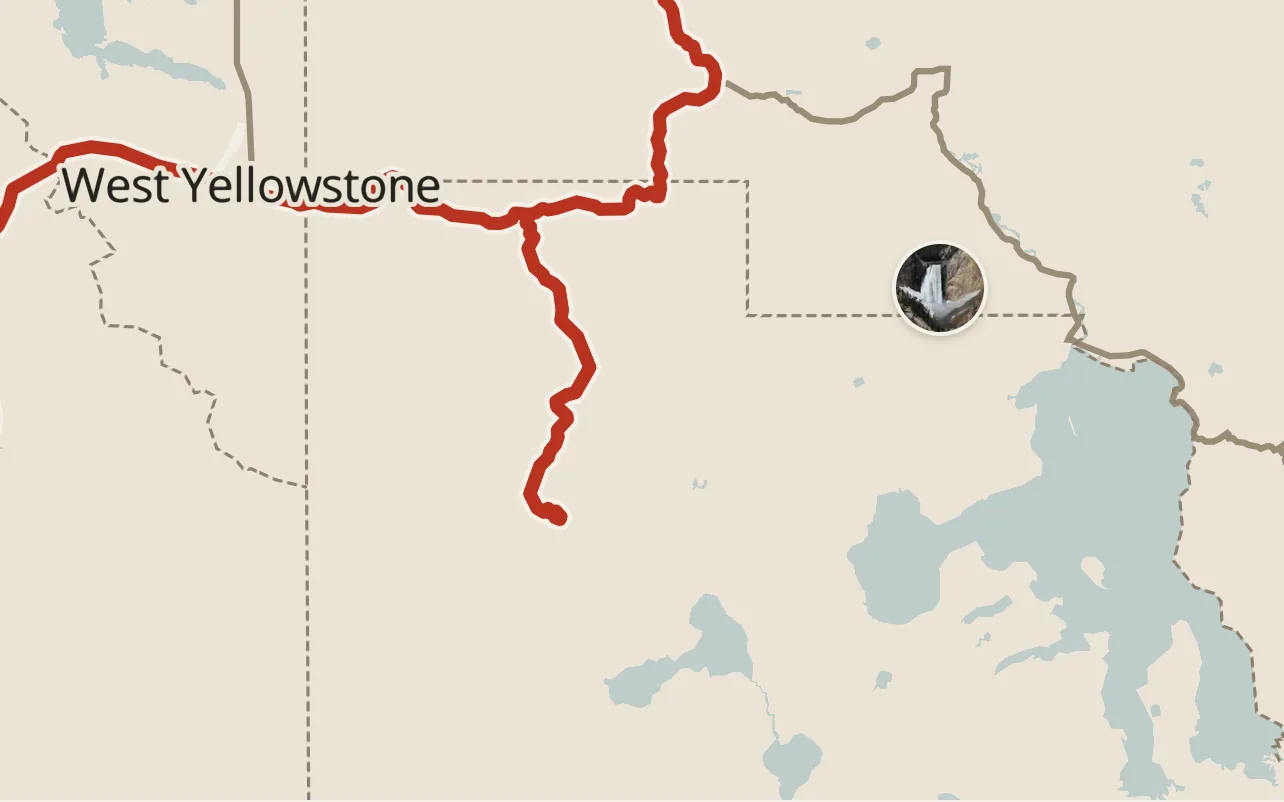
How do we know a route is the fastest?
Finding the fastest loop through 49 stops is a famous puzzle in math, called the traveling salesman problem. The number of possible orders runs 62 digits long, so no computer could ever try them all.
It doesn't have to. The solver starts by working out the least driving time any loop could possibly need. Then it searches until it finds a loop that hits that mark. Once it does, a faster loop can't exist. Then a separate method does the whole job again and has to land on the same answer.
That's what "proven optimal" means here. The 2015 maps came close to the best route. The 2026 trips are the best route.
12,
Possible orders for the 49 landmark stops
Even at a billion orders a second, checking them all would take about 4 times 10 to the power of 44 years. The Sun will have burned out long before then.
How were the landmarks chosen?
Each state's landmark is the place travel writers name most often. I gathered 14 published lists that each pick a top place in every state, from outlets like U.S. News & World Report, Reader's Digest and Fodor's. Then I counted the votes. The place named most often wins its state.
Every winner also had to work as a road-trip stop: open to the public, a single place rather than a whole city, and reachable by car or by a short boat ride from a parking lot.
 Independence National Historical Park
 French Quarter
 Las Vegas Strip
The national parks
There are 63 U.S. national parks. The 2026 trip visits all 51 in the lower 48 states, skipping only the parks in Alaska, Hawaii, American Samoa and the Virgin Islands. That's the 47 parks from the 2016 trip plus 4 created since: Gateway Arch, Indiana Dunes, White Sands and New River Gorge. Each park stop is a main visitor center, and each one has notes on seasons and access.
How does the trip builder work?
When you build your own trip, the search for the best order runs right in your browser, and it proves its answer the same way. Nothing gets sent to a server, and you don't need an account. You can pick as many stops as you like, and even the full list solves in a few seconds on a phone.
- 1Arches National Park331 mi, 6 h 55 min to Grand Canyon National Park
- 2Grand Canyon National Park250 mi, 5 h 39 min to Zion National Park
- 3Zion National Park85 mi, 2 h 10 min to Bryce Canyon National Park
- 4Bryce Canyon National Park123 mi, 3 h 4 min to Capitol Reef National Park
- 5Capitol Reef National Park156 mi, 3 h 15 min to Canyonlands National Park
- 6Canyonlands National Park29 mi, 49 min to Arches National Park
Credits
| What | From | License |
|---|---|---|
| Road network, places, route data | © OpenStreetMap contributors | ODbL 1.0 |
| Basemap tiles | Protomaps, from OpenStreetMap and Natural Earth | ODbL; public domain |
| In-browser route solver | HiGHS (highs-js) | MIT |
| Map rendering | MapLibre GL JS, PMTiles, the Protomaps basemap style | BSD-3-Clause |
| Map labels and icons | Noto Sans glyphs and icons from protomaps/basemaps-assets | OFL 1.1; MIT |
| Stop photos | The National Park Service and others (see the photo credits) | Mostly public domain; a few CC BY, credited |
| National park data | National Park Service API | Public domain |
| Type | Newsreader (Production Type); Overpass (Delve Withrington, Red Hat) | OFL 1.1 |
| The 2015 projects | Dr. Randal S. Olson | Code MIT; writing CC BY 4.0 |
Downloaded route files (GPX, KML, GeoJSON) are derived from OpenStreetMap and carry the ODbL notice. If you reuse them, credit "© OpenStreetMap contributors" and share adapted databases under the ODbL. The posters are rendered maps (Produced Works under the ODbL) and carry the same credit.
Thanks to Bill Cook, whose 2015 work showed how close the original maps came to the best possible route, and whose research on the traveling salesman problem helped make exact answers practical.